
Understanding Your Life Stage & Goals
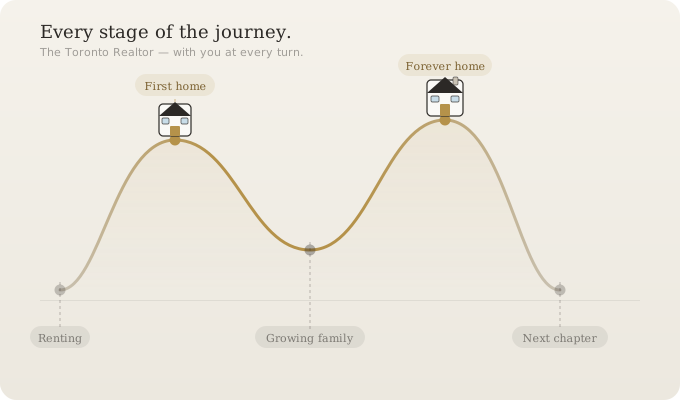
No two clients are the same, and a strategy that works brilliantly for a 28-year-old professional entering the market for the first time looks nothing like the strategy that serves a growing family searching for their forever home. Before we talk about listings or neighbourhoods, we talk about you: where you are in life, where you're headed, and what this move needs to accomplish.
The Young Professional
For a young professional buying their first property in Toronto, the primary objective is almost always the same: get into the market, start building equity, and do it in a way that fits your current lifestyle without overextending. That might mean a well-located one-bedroom or one-bed-plus-den condo in a high-demand core neighbourhood, somewhere you genuinely want to live, in a building with strong fundamentals that will hold value and attract quality buyers or tenants when it's time to move on.
We help you think beyond the monthly payment. The right first purchase isn't just affordable - it's strategic. It's a property that builds your net worth quietly in the background while you build your career.
The Family Ready to Settle Down
For a family with children, or planning for them, the calculus shifts entirely. Space matters. Neighbourhood matters. And above all, school catchment areas matter enormously. We work with many families for whom the quality of local schools is the single most decisive factor in choosing a home, and we take that seriously.
Toronto's top public schools are among the best in the country, but their catchment boundaries are hyper-local. A street, sometimes even a side of a street, can be the difference between enrolment at a high-performing school and not. We know these boundaries, we track them, and we factor them into every neighbourhood conversation we have with families.
Aligning With Your Priorities
Once we understand your life stage, we align our entire strategy around what actually matters most to you, not a generic checklist of features, but your real, ranked priorities. For most of our clients, two goals sit near the top of that list: building long-term equity in their primary residence, and understanding the extraordinary tax advantages that come with homeownership in Canada.
Building Equity in Your Primary Residence
Real estate has historically been the most reliable and accessible wealth-building vehicle available to everyday Canadians, and in Toronto, that principle holds with particular force. When you purchase a primary residence, you are not just buying a place to live. You are acquiring an asset that grows in value over time while simultaneously being the only asset class in Canada where that growth is entirely tax-free.
The Principal Residence Exemption (PRE) is one of the most powerful and underappreciated financial tools available to Canadians. Under the PRE, if a property qualifies as your principal residence for every year you own it, you pay zero tax on the capital gain when you sell, regardless of how much it has appreciated. There is no cap on the exemption. There is no threshold above which it phases out. It is simply 0% on your gain, full stop.
To put that in perspective: if you purchase a detached home in Toronto today and sell it 15 years from now for $600,000 more than you paid, every dollar of that gain belongs entirely to you. Compare that to the same $600,000 gain in a non-registered investment portfolio, where roughly half could be subject to inclusion in your taxable income. The asymmetry is stark, and it's one of the most compelling arguments for homeownership as a core pillar of long-term financial planning.
Toronto Is Still Growing - And That's Not Changing
The home you buy today will, in all likelihood, be worth considerably more in 10 to 15 years, not because of speculation or market exuberance, but because of the structural forces shaping Toronto's future. Toronto is the fastest-growing major city in North America by population, and the fundamentals driving that growth are durable.
Consider what is being built right now and what is coming: the Ontario Line subway expansion will connect 15 new stations and reshape commuter patterns across the city. New transit infrastructure consistently drives property value appreciation in the corridors it serves - that's not an opinion, it's a pattern repeated in every major city that has expanded rapid transit. Beyond transit, Toronto is entrenching itself as a global hub for artificial intelligence research through the Vector Institute and adjacent academic and private-sector investment. The city's financial services sector remains the largest in Canada. Healthcare and life sciences employment is growing at the intersection of MaRS Discovery District and a constellation of world-class hospitals and research institutions. And the EV and clean technology sector is adding a new layer of high-income employment to a labour market that is already among the most educated in the world.
Fact-Based Decision Making
The third pillar of our approach is the one that most directly distinguishes us from the typical real estate experience: we make decisions based on data, depth, and analytical rigour, not surface-level comparables and gut feel. When you work with The Toronto Realtor, you get a well-versed, granular understanding of every property you consider and every market condition that shapes its value.
Advanced Market Analytics
We use advanced analytics to help our clients understand the current state of the Toronto residential real estate market in real terms. Whether you are a buyer or a seller, our team goes well beyond pulling a list of recently sold properties in the neighbourhood. We dig into the data to give you a clear picture of what is truly driving value, and what is not.
Most agents price a property or evaluate an offer based on bedroom and bathroom counts and a handful of recent sales nearby. We go deeper. We identify the specific attributes that differentiate one property from another, quantify that differentiation in pricing terms, and use that analysis to help you make the right call, whether that means knowing exactly what to offer, exactly what to list at, or exactly when to walk away.
What We Actually Look At
Our analysis begins with the fundamentals - the features of a home that hold their value over decades, not just the cosmetic finishes that photograph well and age quickly. We look at floor plan layout: whether the flow is functional, whether the square footage is usable, and whether the layout will appeal to future buyers. We look at exposure: a south-facing home in a Toronto winter is meaningfully different from a north-facing one, and that difference belongs in the price. We know what to look for in a detached freehold home versus a condo unit, because the value drivers are genuinely different.
For condos, we assess the building's financials, reserve fund status, management quality, ownership-to-rental ratio, and the specific unit's floor, exposure, view corridor, and layout efficiency. For freehold homes, we assess lot dimensions, setbacks, addition potential, basement height, mechanical age, and the structural story beneath the cosmetic surface.
Our Expert Partner Network
To further strengthen the confidence behind every purchase decision, we have assembled a team of trusted expert partners who join us in the due diligence process. Buying a home is not just a financial decision - it is also a technical one, and we make sure you have the right people in your corner before you commit.
Home Inspectors
Thorough, independent inspections that go beyond the checklist to identify deferred maintenance, safety concerns, and hidden repair costs.
Licensed Electricians
Electrical assessment for older homes: knob-and-tube, panel capacity, and code compliance - no surprises after closing.
Foundation Engineers
Structural specialists who evaluate foundation integrity, cracking, waterproofing, and long-term stability before you make an offer.
Environmental Consultants
Assessment for older properties where environmental factors, including soil, drainage, and air quality, that can affect value and habitability.
Our partner network means you go into every purchase with your eyes open. We know exactly what price to recommend because we know exactly what we are buying, not just what it looks like, but what it is made of, how it was built, and what it will cost to own.
Understanding the Seller - A Layer No Other Agent Offers
Perhaps the most distinctive element of our fact-based approach is one that operates entirely behind the scenes: our ability to understand the seller's sentiment and motivation before you ever make an offer. Most buyers negotiate blind - they know the asking price and the days on market, and that's about it. We know considerably more.
Using AI-enabled models, we map out the full history of a property across every available touchpoint: listing history, price adjustments, time between relists, ownership duration, mortgage registration dates, and more. We layer that property-level intelligence on top of macroeconomic data: interest rate environment, days-on-market trends, inventory dynamics in that specific micro-neighbourhood, and broader economic sentiment indicators. The result is a nuanced picture of how motivated the seller truly is, and how much room exists in the negotiation before we approach.
This is the layer that separates a great outcome from a good one. It's not something you can replicate with a quick scan of Realtor.ca. It requires data fluency, analytical tools, and the experience to know how to act on what the data is telling you. That is what we bring to every transaction.
Ready to Make a Move?
Whether you're buying your first home, upgrading for your family, or selling strategically, let's build a plan around your life stage, your priorities, and the facts.
Get Your Strategy →